When Benjamin Franklin helped negotiate the Treaty of Paris in 1783 that ended America's Revolutionary War, he used a map called The Mitchell Map, to fix the international boundary.
The Mitchell Map was created by a gentleman named John Mitchell, and one of the interesting things about him was that he was not a professional map maker or geographer. Instead, he was a physician and an amateur (albeit enthusiastic) botanist.
Why should you care about his interest in botany? Mitchell eventually became somewhat of an expert in exotic plants, and his interest in the subject caused him to meet some influential people in government. One of these people was a fellow named George Montagu-Dunk, 2nd Earl of Halifax.
Halifax is important because he was appointed President of the Board of Trade and Plantations by the British government in 1748. The position was basically in charge of promoting trade in the New World. It was his job to make sure Britain made money and controlled the region.
Britain wasn't the only ones interested in the region, of course. The French had the same idea, and lets not forget the Spanish, Dutch, and Native people.
Anyway, Halifax was so impressed with Mitchell that he asked Mitchell to make him a map of North America, which Mitchell, the physician and botanist, completed in 1750. The map was titled "A Map of British and French Dominion in North America," and was heavily skewed to show British dominance, which isn't surprising.
Most scholars believe it was also intended to show the British that there was a significant French threat in the region, probably because Halifax advocated war with the French, or, at least he thought it was inevitable.
The map was reprinted in 1755, and even though there were heavy criticism of it and it was revised several times up until Mitchell's death in 1768, it was the primary map of North America when Ben Franklin got hold of to negotiate peace with the British.
Now, here's why all this is important to Iron Range history. There were several different Mitchell maps used during negotiations which showed different kinds of boundaries. One area of dispute was the Iron Range.
The Range was very nearly a part of what would become Canada, and, given the region's enormous (but then unknown) natural resources, the future of the nation could have looked vastly different if it hadn't been for a crude map, Ben Franklin's famous red pen and ignorance on everyone's part about what was under those trees on Minnesota's Iron Range.
Tuesday, August 6, 2013

Wednesday, June 5, 2013
The SSSSSSSLLLLLLLLLLLLLLOOOOOOOOOOOWWWWWWWWWW moving Earth
Did you know the ground beneath you is moving?
It’s true. The earth’s upper crust, the stuff we stand on,
is actually “floating” along on things we call “plates.”
How fast does it move? Most plates move about two inches per
year. That’s about the same rate that your fingernails grow.
It also means scientists calculate that in 15 million years,
if the plates continued on their current path and barring any disaster, Los
Angeles and San Francisco will be right next to each other.
Right now they’re 400 miles apart.
All sorts of crazy things happen because of these plates.
Learn more about them at MDC’s “When the Earth Shakes” exhibit on display now.
Tuesday, August 21, 2012
"Why Treaties Matter" with our Partner Bois Forte Museum

Visit Bois Forte Heritage Museum! They have been a HUGE partner and resource for us with our new permanent exhibits. We've just put out a grant to fund the installation of it, so we're keeping our fingers crossed! In the meantime, living and loving nature the way that most Iron Rangers do, Treaties do Matter.
Review of "Why Treaties Matter" by Mai Vang, Curator
The exhibit was extraordinarily informative. With only 20 panels and a touchscreen interactive, the exhibit designers were able to teach about the complex history and nature of treaties. Treaties are legally binding agreements between sovereign nations, here it is between the United States and Native nations. One of the great strengths of this exhibit are the first hand quotes like the one below that succinctly sums up what the treaties were all about.
Not only were the historical content in the exhibit both deep and thorough covering a long time period and many different tribes and groups in Minnesota, but this exhibit was community-based. Which is, in the museum world, cutting edge. Community members were consulted from different Ojibwe and Dakota bands, which is why I believe this exhibit is so successful and strong. The voices of the people guide the direction of the exhibit adding multiple views but able to maintain a consistent flow. I know I'm biased because I work in this field, but this is one of the best exhibits I've seen. Not once was I bored, and I actually WANTED to read all of the words and labels. Props to the designers. The web companion is full of even more information to explore. So take a trip out to Bois Forte Heritage Center and explore another culture that's in your backyard."I understand what you want... from the few words I have heard you speak. You want land."—Flat Mouth [Aish-Ke-Vo-Go-Zhe, or Bird with Leaf Green Bill], Ojibwe leader at 1855 treaty
(I'm using "band" here as a general way to describe each sovereign nation, but I understood from the interactive touch screen in the exhibit that some groups do not like to be called bands because they are not merely a group of people who banded together, but a group of organized sovereign people. See?! Case in point, I learned a lot from this exhibit.) www.treatiesmatter.org
http://www.boisforte.com/divisions/heritage_center.htm
Friday, June 15, 2012
Furs!
 I received furs in the mail! My exhibit team and I are working on renovating our permanent exhibit. One of the stations we wanted to have is a tactile, touchable, station where visitors can feel different kinds of fur. I searched, and literally, emailed every single email I could find for taxidermists in the state of Minnesota. Viola! I found four kinds that I'm looking for!
Can you guess which belongs to which animal?

Clue:
Bear
Deer
Caribou
Moose
Friday, May 11, 2012
Coming up for air...
from an fantastic week of exciting FUN!
What a week! We had 140 5th graders, five paraprofessionals, and six teachers, from Roosevelt Elementary School visiting for their Community Quilts' big open with cake and juice. The Going to Pieces Quilters Guild put together five quilts with squares made by the students. These will hang around the town of Virginia, so you'll be seeing it in your neighborhood. One of our major goals this year is to connect with our communities. But we didn't just want to connect with them, we wanted them to connect with each other, too.
That was Kathy Annette's (President/CEO of the Blandin Foundation) major point, that leaders cannot work alone, today at Empowher. That also applies to communities. Kathy pointed out that there are so many elements that must be balanced in order to make create a healthy community. Just looking at the quilts, you can see all the different pieces that puts together a community for these 5th graders. Olcott Park, Thunderbird Mall, Virginia High School, the Minnesota Loon, homes, hockey, the police, Blue Devils are a handful of Virginia's community represented on these quilts. Come and see them at the Minnesota Discovery Center. They'll also be 'hanging' out at the Virginia Public Library this summer and other places in the community in the upcoming year.
Tomorrow, Saturday, May 12 will be a celebration of quilts for the Going to Pieces Quilters who have contributed so much to our communities. They make quilts for shelters, babies, homes, they keep fiber arts traditions alive, and they volunteer so many hours for our communities. Join our community tomorrow to enjoy the quilt arts with your families!
Phew.
 |
| One of the Community Quilts |
What a week! We had 140 5th graders, five paraprofessionals, and six teachers, from Roosevelt Elementary School visiting for their Community Quilts' big open with cake and juice. The Going to Pieces Quilters Guild put together five quilts with squares made by the students. These will hang around the town of Virginia, so you'll be seeing it in your neighborhood. One of our major goals this year is to connect with our communities. But we didn't just want to connect with them, we wanted them to connect with each other, too.
That was Kathy Annette's (President/CEO of the Blandin Foundation) major point, that leaders cannot work alone, today at Empowher. That also applies to communities. Kathy pointed out that there are so many elements that must be balanced in order to make create a healthy community. Just looking at the quilts, you can see all the different pieces that puts together a community for these 5th graders. Olcott Park, Thunderbird Mall, Virginia High School, the Minnesota Loon, homes, hockey, the police, Blue Devils are a handful of Virginia's community represented on these quilts. Come and see them at the Minnesota Discovery Center. They'll also be 'hanging' out at the Virginia Public Library this summer and other places in the community in the upcoming year.
Tomorrow, Saturday, May 12 will be a celebration of quilts for the Going to Pieces Quilters who have contributed so much to our communities. They make quilts for shelters, babies, homes, they keep fiber arts traditions alive, and they volunteer so many hours for our communities. Join our community tomorrow to enjoy the quilt arts with your families!
Phew.
-Empowher was an event held at the Minnesota Discovery Center on May 11, to promote and encourage women (and men) leaders in our community.
-Going to Pieces 30 year celebration starts at 9 am. Darlene Zimmerman, accomplished quilt expert, will speak at 10 am. Demonstrators galore. Admission applies for our events. Members always free.
Wednesday, March 14, 2012
How are quilts judged? talk at MDC update
 |
| Quilt Exhibit at MDC. Photo by Deborah McCauley |
The Minnesota Discovery Center will be holding events in honor of National Quilting Day in partnership with the Going to Pieces Quilt Guild
March 17, 2012 from 11:30 AM – 3 PM
How are quilts judged in contests?
Tips from Karen Lamppa, a previous judge.
- Demonstrations on paper piecing and embellishment by Karen Lamppa
- Share the joy of quilting with children through kids' quilting crafts and a story time about quilts
Regular admission applies $5/adults; $3/children; members Free.
11:30 AM – 12:30 PM Karen Lamppa talk about judging quilts in contests
12:30 PM – 3 PM Kids Crafts and story time
1 – 3 PM – Karen Lamppa demonstration
Tuesday, March 13, 2012
"How are quilts judged?" Talk at MDC
The Minnesota Discovery Center will be holding events in honor of National Quilting Day in partnership with the Going to Pieces Quilt Guild
March 17, 2012 from 11:30 AM – 3 PM
How are quilts judged in contests?
Tips from Karen Lamppa, a previous judge.
- Demonstrations on paper piecing and embellishment by Karen Lamppa and Barbara Rinne
- Share the joy of quilting with children through kids' quilting crafts and a story time about quilts
Regular admission applies $5/adults; $3/children; members Free.
11:30 AM – 12:30 PM Karen Lamppa talk about judging quilts in contests
12:30 PM – 3 PM Kids Crafts and story time
1 – 3 PM – Barb Rinne and Karen Lamppa demonstrations
Friday, March 9, 2012
Medals of Congressman John A. Blatnik
 |
| John A. Blatnik |
 |
| Pins and buttons from the John A. Blatnik Collection. |
Congressman John A. Blatnik was born in Chisholm, MN. He was chemistry teacher in Chisholmbefore serving as senator from 1940-1944. At the age of 29 in 1940, he was the youngest member ever elected to the Minnesota State Senate. In 1942, he joined the United States Army Air Corps as chief of the Office of Strategic Services’ mission. His familiarity with the Slovenian and Serbo-Croatian languages helped him while working behind German lines as an intelligents agent. He set up a system that rescued nearly 400 downed airmen, earning him the rank of captain and many medals.
In 1946, Congressman Blatnik was elected to congress and won 13 times more. He wrote the Clean Water Act, which passed in 1972.
 |
| Bronze Medal Star, the fourth highest combat award. John A. Blatnik Collection. |
 |
| USFA Medal. John A. Blatnik Collection |
Wednesday, February 22, 2012
It's Been A While: Updates and An Old Wrench
We are chugging away developing programs and exhibits for our next busy season. In the meantime, join us for sensational music by local musicians and see our current exhibits!
To receive emails about our upcoming events and exhibits contact Deborah McCauley at dmccauley@mndiscoverycenter.com
 |
| Acoustic Cafe with Band |
Acoustic Café ~ Every Thursday from 5-9 p.m. ~ Enjoy acoustic music by talented local musicians. ~ Appetizers, drinks and homemade soups available on our menu. Admission is free. Come check it out!
Going to Pieces Quilt Exhibit: Now through June 17th
Going to Pieces Quilt Guild celebrates its 30 year anniversary with approximately 30 members. The exhibit showcases 90 quilts and quilted objects from 18 members. You can see the creative advances from their first to most current quilts. Within each quilt the women’s personalities show through from humor to artistic vision.
Sketchers & Carvers Exhibit in the Community Gallery: Now through April 1st.
OBJECT OF THE MONTH
 | ||
| Antique Wrench from the Minnesota Discovery Center Artifact collection |
Notice all of the different sizes on one tool? Cool, huh?
Can you find interesting tools around your house?
To receive emails about our upcoming events and exhibits contact Deborah McCauley at dmccauley@mndiscoverycenter.com
Wednesday, December 21, 2011
Happy Holidays from the Staff at the Minnesota Discovery Center
Holiday photos from around MDC.
 |
| A bird's nest made out of grass. |
 |
| Textures of basketry made by our demonstrators. |
 |
| A basket that uses a horn as a handle. |
 |
| Lace-like basket designs. Again made by our demonstrators. |

 | |
| Plucky all dressed up for the holidays. |
 |
| A beautiful sunset towards Hibbing from our Overlook. |

Wednesday, December 7, 2011
Creating Panorama Photographs for Train Exhibit
 | |||
| Laurentian Rail Road Club Train Model |
 |
| Sand Trap Panoramic |
 |
| Golf Course Panoramic |
 |
| Lumber Equipment Panoramic |
Photos courtesy of John Linstromberg.
Panoramic Stitching Tutorials
Stitching Photos in Photoshop at phong.com
This one is very advanced. The author of this site prefers to tweak his photographs after he uses the
Photomerge function (Photoshop CS3: File>Automate>Photomerge). If you're interested in fixing the "mask" yourself, this one will be helpful.
Photoshop Cafe Auto Alighn and Auto Blend at photoshopcafe.com/cs3/smith-aa.htm
This one is more straightforward and for someone who is new at stitching was the easiest way to do it. You will need Photoshop CS3 (not sure if the other versions work... try it!)
8 Guidelines to taking panoramic photos with any camera by Digital Photography School
Short, easy to read on taking good photographs to create panoramas.
Using Photomerge, another Technique to create panorama
Again, by Digital Photography School
TIP:
When taking the photograph, one should overlap the shots, otherwise Photoshop won't know how to stitch and blend.
Happy photographing and panoramic making!
Thursday, December 1, 2011
Good stuff in the Community Gallery
We’re currently showing what I think is our best Community Gallery yet: Sketchers and Carvers. The variety of work and the number of pieces - woodburning, woodcarving, pen drawings, pencil grids, black ink on taconite-dyed paper, colored ink and more – make it an interesting show. Even if you just breeze through the space you get a sense of shapes, dimensions and texture. For a small area, it has a lot going on: 60+ submissions with more than 75 pieces from nine regional artists.
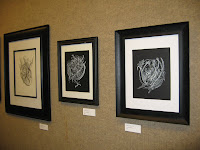
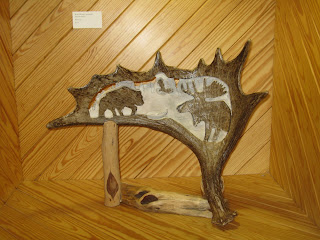
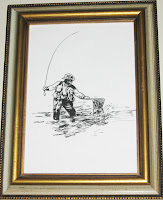
But somehow it’s not overwhelming. I feel fortunate to have been able to meet most of the artists who contributed to this exhibit. They were all wonderful to work with and I only hope they’re happy with how we’ve displayed their work. Mai did a great job displaying the carved sculpture pieces and we are extremely lucky to have an MCAD grad on staff. We all got a little creative in the layout, but it feels like it works. Many of the pieces are for sale, and there are more than a couple I would like to buy. The thing I love about our Community Gallery is it gives people with all levels of gallery experience a chance to share their work. The great response to the call for entries tells me there are plenty of talented people on the Range who want opportunities to show what they do. We’re happy to accommodate! See the show through March, and you’ll see what I mean. For artists' names and more info, click here. -BP


But somehow it’s not overwhelming. I feel fortunate to have been able to meet most of the artists who contributed to this exhibit. They were all wonderful to work with and I only hope they’re happy with how we’ve displayed their work. Mai did a great job displaying the carved sculpture pieces and we are extremely lucky to have an MCAD grad on staff. We all got a little creative in the layout, but it feels like it works. Many of the pieces are for sale, and there are more than a couple I would like to buy. The thing I love about our Community Gallery is it gives people with all levels of gallery experience a chance to share their work. The great response to the call for entries tells me there are plenty of talented people on the Range who want opportunities to show what they do. We’re happy to accommodate! See the show through March, and you’ll see what I mean. For artists' names and more info, click here. -BP
Wednesday, November 30, 2011
Museum Presentation
I made a presentation on what we are doing at the Minnesota Discovery Center to our board. Below is a short version of that presentation which defines what museums are, notes some of our exhibit and object collections challenges, includes our solutions to those challenges. I have hyperlinked websites that I find useful. I hope that you can get something out of it too!
I will write an update on what we've actually done in the museum and how it's working on another blog. Look out for it!
I will write an update on what we've actually done in the museum and how it's working on another blog. Look out for it!
Tuesday, November 29, 2011
What is this?: Found with Kitchen utensils
 | |
| Wooden kitchen utensil, slant tip, round handle; found in collection |
What do you think it is?
Wednesday, November 16, 2011
Give to the Max

Minnesota is one of those great states that has so much funding sources, non profits, and progressive ideas to to make our communities better. Give to the Max for the Minnesota Discovery Center (click button above). Remember that we get a dollar for dollar match; double your community support!
Wednesday, November 2, 2011
News: MDC Table and Small Exhibit at the Governor's Open
Come see all the excitement at Giants Ridge!
Read about the details on Range News.
Lodge at Giants Ridge
Reception
Thursday, November 4 at 7 PM
Lodge at Giants Ridge
“Big Buck” Luncheon
Friday, November 5th at 11 AM
We will have a table and some awesome historical photographs!

Read about the details on Range News.
Lodge at Giants Ridge
Reception
Thursday, November 4 at 7 PM
Lodge at Giants Ridge
“Big Buck” Luncheon
Friday, November 5th at 11 AM
We will have a table and some awesome historical photographs!

Hunters in the street displaying deer and grouse near Hibbing, Minnesota
William R. Opie Photographic Collection
Iron Range Research Center
1984.0486 0000968-tn
Monday, October 31, 2011
A Super Cute Video on Museum Manners
No Touching, No Running, No, NO NO... These are rules to confine people to themselves in museums. They are complete turn offs for me and visitors, too. However, the Minnesota Discovery Center have incredible and historical objects that need to be protected. So museums have been coming up with creative fun ways to get the message across but still be very welcoming. Watch this 2 1/2 minute video that will make you laugh, appreciate, and want to visit your local museum. "No Dragons Allowed."
Monday, October 24, 2011
How To: Simple Wall-to-Wall Inventory
One of the major responsibilities of a museum is to its object collections. About a year ago the Minnesota Discovery Center embarked on a major wall-to-wall inventory of our objects with the help of the Minnesota Historical and Cultural grant. Although some inventory was conducted before, there were incomplete information in the documentation.
Documentation is the most important part of a museum's collection. Without it no one would know where an object came from, what it is, and where it is located.
Before you start your wall-to-wall inventory, there are some basic registration (the act of registering/documenting an object) that needs to be in place. We used this type of system: 1998.2.3.
1998 represents the year that the collection came in through our doors.
2 represents that this is the second collection that came in through our doors in 1998.
And 3 represents that third object in this collection that was recorded.
1998.2 is the accession number and 1998.2.3 is the object ID number. Each object will have its own ID number.
Here is the most simple way to conduct a wall-to-wall inventory.
Using a notebook or inventory sheet you should have this information recorded: Accession/Object ID, Description, Measurements, Home Location, Date Completed, and Completed by. Click to see an example of our inventory sheet.
Notes:
The description should describe what the object is, color, distinguishing marks, maker's marks, text that appear on the object. If you walk back into the storage using these descriptions, you should be able to make a good judgement of which object it is. The more information you have on hand, the better it is for future research on this object. If you don't have this information, save the research for another day and another project. HINT: If you tag your objects with subjects in addition to the description, it will make it easier for you to find an objects for specific searches.
The Home Location is a permanent place where you will store your object. Different areas in your storage space should be lettered or numbered, each column and/or shelf should be numbered. If you were given a letter D.4.5, you should be able to find where the object is in your collection room. D could mean it is on the wall that is given the name D. 4 means it is the fourth column, and 5 means it is on the fifth shelf. Number your storage area in a way that would make sense for you to find the objects in your collection.
Digitally recording this information will be very helpful in locating objects quickly. We use PastPerfect a museum software. It's at $870 today. Excel is simple and inexpensive alternative. Once you have the money to purchase software like PastPerfect, it can be quickly transferred into PastPerfect. A simple Google search under "museum database software" will bring up a lot of websites and other software. Interview some other historical museums (such as the Minnesota Historical Society) to learn about what they use and why they use it.
Work from one end of the room to the other. This will be a painfully long process, but the outcome will be well worth it for decades.

This is from our collection storage. Notice that we tag our objects? We include the object ID number. Notice also the documents with the objects? It helps to have these documents with the objects so that we can quickly identify what collection the object comes from. As we inventory, we also line our shelves with a polyethylene foam so that metal objects aren't touching our metal shelves and wrap sensitive objects in acid free tissue.
Here are more resources about registration, collections care, inventory, and documentation.
Running a Museum PDF - a practical handbook. Everything and anything you will need to know about how to run a museum. Includes information on care of collections, care of visitors, management, marketing, disaster preparedness, and illicit trafficking.
Connecting to Collections - Has online resources.
Re-Org: is a great resource for small museums like the ones here on the Range. It highlights storage reorganization, documentation, and offers case studies on collection care. It was created in order for "Preventive Conservation of Endangered Museum Collections in Developing Countries.”
National Park Service Museum Management Program - Thorough pdf resources on managing collections
Documentation is the most important part of a museum's collection. Without it no one would know where an object came from, what it is, and where it is located.
Before you start your wall-to-wall inventory, there are some basic registration (the act of registering/documenting an object) that needs to be in place. We used this type of system: 1998.2.3.
1998 represents the year that the collection came in through our doors.
2 represents that this is the second collection that came in through our doors in 1998.
And 3 represents that third object in this collection that was recorded.
1998.2 is the accession number and 1998.2.3 is the object ID number. Each object will have its own ID number.
Here is the most simple way to conduct a wall-to-wall inventory.
Using a notebook or inventory sheet you should have this information recorded: Accession/Object ID, Description, Measurements, Home Location, Date Completed, and Completed by. Click to see an example of our inventory sheet.
Notes:
The description should describe what the object is, color, distinguishing marks, maker's marks, text that appear on the object. If you walk back into the storage using these descriptions, you should be able to make a good judgement of which object it is. The more information you have on hand, the better it is for future research on this object. If you don't have this information, save the research for another day and another project. HINT: If you tag your objects with subjects in addition to the description, it will make it easier for you to find an objects for specific searches.
The Home Location is a permanent place where you will store your object. Different areas in your storage space should be lettered or numbered, each column and/or shelf should be numbered. If you were given a letter D.4.5, you should be able to find where the object is in your collection room. D could mean it is on the wall that is given the name D. 4 means it is the fourth column, and 5 means it is on the fifth shelf. Number your storage area in a way that would make sense for you to find the objects in your collection.
Digitally recording this information will be very helpful in locating objects quickly. We use PastPerfect a museum software. It's at $870 today. Excel is simple and inexpensive alternative. Once you have the money to purchase software like PastPerfect, it can be quickly transferred into PastPerfect. A simple Google search under "museum database software" will bring up a lot of websites and other software. Interview some other historical museums (such as the Minnesota Historical Society) to learn about what they use and why they use it.
Work from one end of the room to the other. This will be a painfully long process, but the outcome will be well worth it for decades.

This is from our collection storage. Notice that we tag our objects? We include the object ID number. Notice also the documents with the objects? It helps to have these documents with the objects so that we can quickly identify what collection the object comes from. As we inventory, we also line our shelves with a polyethylene foam so that metal objects aren't touching our metal shelves and wrap sensitive objects in acid free tissue.
Here are more resources about registration, collections care, inventory, and documentation.
Running a Museum PDF - a practical handbook. Everything and anything you will need to know about how to run a museum. Includes information on care of collections, care of visitors, management, marketing, disaster preparedness, and illicit trafficking.
Connecting to Collections - Has online resources.
Re-Org: is a great resource for small museums like the ones here on the Range. It highlights storage reorganization, documentation, and offers case studies on collection care. It was created in order for "Preventive Conservation of Endangered Museum Collections in Developing Countries.”
National Park Service Museum Management Program - Thorough pdf resources on managing collections
Thursday, October 20, 2011
How not to choose paint colors
By Mai Vang, Curator
We are so excited to be recipients of Valspar's Minnesota Beautiful Grant. Through the grant we received 45 gallons of paint! The Bunkhouse, Pillsbury Station, and Turntable received a facelift this fall.
BEFORE

At any rate, the building is now bright and happy. Last chance to see it before winter sets in at our Family Fun Trolley this weekend October 22 and on October 29th.
We are so excited to be recipients of Valspar's Minnesota Beautiful Grant. Through the grant we received 45 gallons of paint! The Bunkhouse, Pillsbury Station, and Turntable received a facelift this fall.
BEFORE

The bunkhouse was donated to MDC by Arnold and Ethel Danielson. Track gangs, men who were building railroad tracks, stayed in buildings like this in the early 1900s.


Whao! Look at that blue. Like any other human being, I took a photograph of the old bunkhouse and held it up against the samples of paint. Blue Balance 40021. Perfect. On paper. After our buildings and grounds crew painted the building (thanks Loren and Glen!) it turned out to be a playful-doll-house-color-sky-blue. Do not do what I did. Always choose a shade duller and darker. Side of the Bunkhouse.
AFTER


At any rate, the building is now bright and happy. Last chance to see it before winter sets in at our Family Fun Trolley this weekend October 22 and on October 29th.
Friday, October 14, 2011
Peanuts...Naturally Exhibit Summary
We had a 24% increase in visitors during the run of Peanuts...Naturally with
8,811 visitors from June 11 - September 4th!
Charles Schultz created some comic strips on how his Peanuts characters view the world around them. Through the misunderstandings of these characters, the public and readership gained great knowledge about protecting the environment, about trees and birds, and about the universe.
Enjoy some of the photographs from our Peanuts...Naturally programming that focused on visitors' relationships with nature and their surroundings!
 |
| Visitor with potted plant. |
 |
| Butterfly release with Stefanie Carlson, Education Coordinator, and visitors. |
 |
| Staff with Snoopy. |
Subscribe to:
Posts (Atom)