Tuesday, August 30, 2011

Summer Photography Workshop at MDC

By Mai Vang, Curator

The "Grace" exhibit inspired me to host 3-Day sessions of Beginners and Intermediate workshops. Eric Enstrom from lil' ol' Bovey took this famous photograph.

Photograph taken by Eric Enstrom of Charles Wilden in 1918.

I cannot believe how many functions of a camera there are! Pete Davis, a professor from Hibbing Community College and Joe Edman, a photographer taught the two sessions. Below are some photographs I took after learning some techniques. Enjoy! (P.s. We would love to see your photographs from MDC too!)

The Class. Teachers, Pete Davis, third from left and Joe Edman, third from right.

My attempt at photography. Pond at MDC.

We learned the Rule of Thirds. When your
subject is in 1/3 of the frame, the photograph is more pleasing to the eyes.

The CCC (Civilian Conservation Corps.) truck. It actually runs and 
was recently in the Hibbing Parade!

 
One of the greatest features of our grounds are the
historical buildings and structures.
Here are replica outdoor cooking with a beautiful water pot.

Using the 'macro' on the camera always gives
photographs an artistic perspective.

Thursday, August 25, 2011

Mystery Solved

By Mai Vang, Curator

Backlogs of unsolved mysteries sits down in collection for years and years, to no one's fault. As any museum curator/administrator/collections manager knows, that is the nature of the beast.

When I first came on staff, one of the first emails I received was from the St. Louis County Historical Society's collections manager.When the Minnesota Discovery Center, formerly Iron Range Interpretative Center, first started we borrowed some Stuntz items from them... 28 years ago. George Stuntz was a government surveyor who discovered the Vermilion Range iron ore deposits and helped develop Duluth and St. Louis County.

“I came in 1852. I saw the advantage of (Minnesota Point) as clearly then as I do now. On finishing the survey for the government, I went away to make a report, and then returned the next spring and came for good. I saw surely knew then as I do now that this was the heart of the continent commercially, and so I drove my stakes.” -George Stuntz

A couple of weeks ago, I met with staff members from the St. Louis Historical Society and finally returned the items. This is a collection manager and curator's dream. Paperwork and artifacts are back to where they belong and we can continue our jobs in solving more collections mysteries.

Wednesday, July 27, 2011

Traveling Travel Exhibits

By: Mai Vang, Curator

The logistics of moving an exhibit is like moving out of your home. Small exhibits are like an apartment, large exhibits are like moving two-4 bedroom homes. Since my time at the MDC (Minnesota Discovery Center), we received three traveling exhibits. How People Make Things, the largest traveling exhibit I worked with, took up two semi-trucks and a whole week to put together.

Like some spy movie, some museum registrars may be chained to a black briefcase for very special objects while they are traveling long distances. Some might even purchase an airplane seat for it so that it would never leave their sight. That is an extreme case and becoming rare. For larger exhibits, like How People Make Things, a special carrier would be used. Some arts moving trucks would be  temperature controlled. Moving exhibits and objects, although not difficult, takes practice and careful attention. 

Imagine a Van Gogh being thrown around like a UPS package. That would not happen with these special shipping companies. And of course, some traveling exhibits are developed with traveling in mind.

To my relief, Minnesota on the Map, the next traveling exhibit, will be a lot smaller and picked up by an MDC staff from Winona History Center in a 12 foot truck/van. Click to see the logistics of Minnesota on the Map, the next traveling exhibit coming to MDC.

Map from the Minnesota Historical Society collection for Minnesota on the Map exhibit.


Minnesota on the Map Coming August 6!
The Minnesota Historical Society Traveling Exhibits Program has been made possible by the Arts and Cultural Heritage Fund through the vote of Minnesotans on November 4, 2008. Administered by the Minnesota Historical Society. 

Wednesday, July 20, 2011

A great history. A great show.

By Scott Stein

One of the interesting things about living in this area is our unique cultural heritage. Many of our families settled here to work in the mines and start a new life.

We brought our cultures with us, of course, and fought (and continue to fight) to keep them alive here.

On Sunday, August 7, the Discovery Center is presenting the Duquesne Tamburitzans, the longest-running multi-cultural song and dance company in this country. The Tamburitzans are dedicated to preserving the music, songs and dances of Eastern Europe.

There, I got all the proper stuff out the way. Now, let me say this: they’re a great show!


Check them out on YouTube and come out for the show on August 7. It starts at 2 o’clock and tickets are only $10. Also, a special thanks to the Minnesota State Arts Board for sponsoring the show.

Wednesday, June 29, 2011

Finding Mystery Boxes

By Mai Vang, Curator
 
I envy my inventory assistants. They get to handle each and every mysterious object in the collection. In my rush to leave my office to some meeting or other, I glanced at a box and rushed straight back to photograph it.

What treasures are inside of it? Where did it come from? How old is it? Although I believe Jason has learned its secret, the answers allude me, for now.

What mysterious boxes have you found in your attic? Tell us your stories.

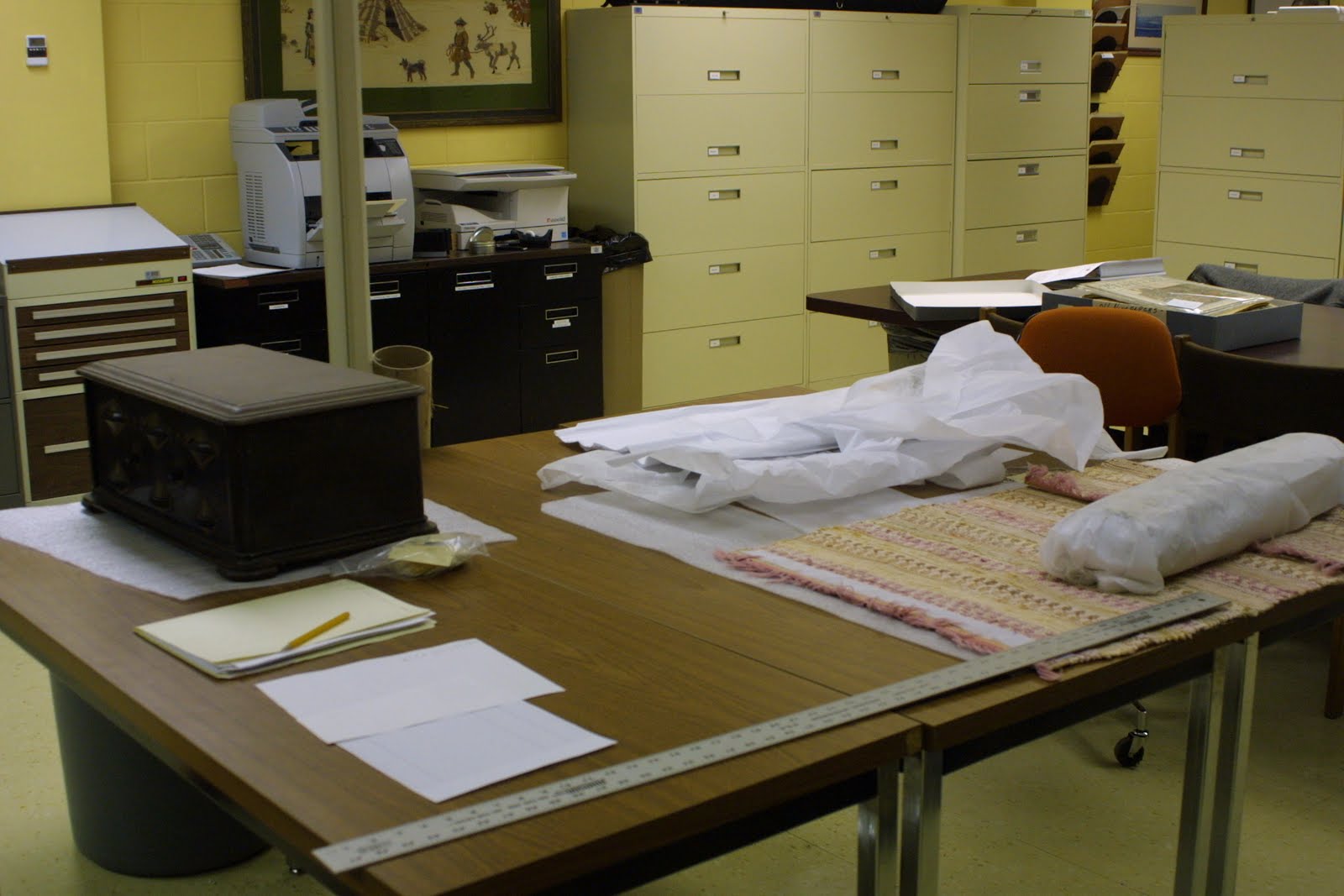
On the left is the mystery box that Jason is inventorying.
On the right is a piece of textile that Mary has finished up and started wrapping.

Inventory: Wall to Wall

By Mai Vang, Curator

Minnesota Discovery Center received a grant through the Arts and cultural Heritage Fund in October 2010 to conduct a wall-to-wall inventory of the object collection. We have an estimated 10,000 + number of objects in the collection that includes everything from the mundane household item to large equipment to artworks.

Our goal: To inventory 10,000 objects by 2013.

Next step: Identify preservation and storage needs to properly care for these historical objects.

By April 27, 2011, Mary Erickson and Jason Scorich have inventoried 3,000 objects! Great job!